Vrijdag, 29 juli 2005
Beautiful paintings

 Lovely artwork by Alex Mooyman. Many paintings are inspired by the Yijing.
Woensdag, 27 juli 2005
Rare uitspraken
Zondag, 24 juli 2005
Sinological Institute, Leiden
 A few weeks ago I was visiting the Sinological Institute in Leiden to do some research. It is a place where I can spend literally hours. Their library is one of the best in Europe, and the librarians are always willing to help you if you are stuck. It is a quiet, peaceful place and I go there as often as I can.
However, the best part of the building is not the library. It is the patio, the square space in the middle of the building which they covered with a beautiful glass-with-wood roof. Furnitured with some small tables and rotan chairs, a Chinese altar and some typical Chinese furniture it is a good place to relax.
Therefore: some photo's of the patio. More photo's of the institute can be found here.
Maandag, 18 juli 2005
A Mulan in the Yijing

(If you see tiny squares where Chinese characters should be you are probably using Internet Explorer. Switch to Firefox, it does a much better job.)
Through several channels the character of hexagram 44, gou 姤, has been brought to my attention. On Hilary's forum there has been some discussion about it, mainly stirred by the view of Margaret J. Pearson as expounded in her article Towards a new reading of hexagram 44 in The Oracle Vol. 2, no. 11 (September 2000). In this article she says,
"I suggest that this character 姤 be read as 'queen' 后, as did Karlgren (GSR 112) or, more precisely, 'the bride of the ruler' (king or duke) 王后, as in the Chunqiu (Spring and Autumn Annals)".
(p. 25)
There is however a problem with this suggestion, because Karlgren never said that 姤 can be read as 'queen' (thanks to Steve Marshall for mentioning this to me). Karlgren says that hou 后 is read as 'sovereign, lord' in the Shijing, as 'queen' in the Zuozhuan, and as loan for 後 in the Liji. Furthermore he says that gou 姤 is read as 'to meet' in the Yijing and as 'good' in the Guanzi (GSR p. 49-50) (this also shows that Karlgren's Grammata Serica Recensa is not a good dictionary, because he only gives a few traditional or accepted translations of a character in the context of the book in which it occurs. These meanings are often far from the original meaning of the character, as can be seen with gou 姤). But nowhere does Karlgren say that gou 姤 can be read as hou 后. Does this mean that 姤 cannot be read as 后? No, there are sources which show that this is legitimate. But these sources also have other implications for the meaning of gou 姤.
Simply put, when you read 姤 as 后, you drop the 女 radical. This is in fact a common feature in oracle bone inscriptions (See Zhang Zenglang, A Brief Discussion of Fu Tzu in K.C. Chang, ed., Studies of Shang Archeology, p. 103 and Zhang Pingchuan, A Description of the Fu Hao Oracle Bone Inscriptions, p. 124-125 in the same book). This happened with titles like fu 婦 (帚), and with clan names like hao/zi 好 (子) and jing 妌 (井). The 女 radical implies that the title concerns a woman. In other words, if you drop the 女 in 姤 and take this is a Shang feature, you imply that 后/姤 is a title or a clan name during (the later part of) the Shang dynasty.
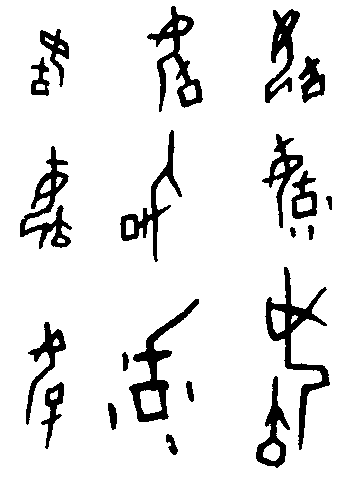
 Let's look at the etymology of 后 for a while. When you look in the 甲骨文字典
for this character (p. 997) you are redirected to the early forms of yu
育/毓 (p. 1581). The old form of this character seems to depict a woman giving
birth to a baby (see image on the right, click to enlarge). Often, but not always, is the baby depicted upside down, and in
some instances the woman is left out (which might imply that the child part is
the important part; the meaning is the child, not the woman). Sometimes the baby carries little drops
around him, which are interpreted as amniotic fluid. That 后 is another form of
育/毓 is suggested by
Wang Guowei 王國維
(1877-1927), who saw 𠂆 as the modified 女,
and 𠮛 as a modified 子 (in
戩壽堂所藏甲骨文字考釋 as mentioned in 甲骨文字典,
p. 1581). On oracle bones 育/毓 refers to the heir, the follower, the next in
line (Tsung-Tung Chang, Der Kult der Shang-Dynastie im Spiegel der
Orakelinschriften, p. 99). It also refers to the posthumous title (miaohao 廟號) of an emperor
(甲骨文字典, p. 1582). In bronze inscriptions it too refers to the heir or succeeder
of the throne. This is in line with the Shuowen 說文,
which says about 后: "后,繼體君也".
Jiti 繼體 refers to the son of the first wife, who succeeds to the throne
("嫡子繼承帝位", 漢語大詞典, 9b.1046).
Let's look at the etymology of 后 for a while. When you look in the 甲骨文字典
for this character (p. 997) you are redirected to the early forms of yu
育/毓 (p. 1581). The old form of this character seems to depict a woman giving
birth to a baby (see image on the right, click to enlarge). Often, but not always, is the baby depicted upside down, and in
some instances the woman is left out (which might imply that the child part is
the important part; the meaning is the child, not the woman). Sometimes the baby carries little drops
around him, which are interpreted as amniotic fluid. That 后 is another form of
育/毓 is suggested by
Wang Guowei 王國維
(1877-1927), who saw 𠂆 as the modified 女,
and 𠮛 as a modified 子 (in
戩壽堂所藏甲骨文字考釋 as mentioned in 甲骨文字典,
p. 1581). On oracle bones 育/毓 refers to the heir, the follower, the next in
line (Tsung-Tung Chang, Der Kult der Shang-Dynastie im Spiegel der
Orakelinschriften, p. 99). It also refers to the posthumous title (miaohao 廟號) of an emperor
(甲骨文字典, p. 1582). In bronze inscriptions it too refers to the heir or succeeder
of the throne. This is in line with the Shuowen 說文,
which says about 后: "后,繼體君也".
Jiti 繼體 refers to the son of the first wife, who succeeds to the throne
("嫡子繼承帝位", 漢語大詞典, 9b.1046).
There is a similarity between the old forms of 后 and that of jun 君, which was also a title. For me this gives weight to the view that 后 is also a title.
What makes it difficult to narrow down the meaning of 后 is the matter that this character also occurs written backwards - a common feature in oracle bone inscriptions, especially with positive-negative charges of divination (the negative charge was written on the same plastron and often had mirrored characters of the positive charge). We also find this in bronze inscriptions (金文大字典, p. 1699; see also Zheng Zhenxiang, A Study of the Bronzes with the "Ssu T'u Mu" Inscriptions Excavated from the Fu Hao Tomb in Studies, p. 82-83, 96-97). This makes it difficult to distinguish 后 from si 司. On the other hand, it could also mean that there is a connection between these two, and that in order to find the complete meaning of 后 we also have to look at 司. In oracle bone inscriptions it is the precursor of ci 祠, which stands for the presenting of food as a sacrifice to the ancestors or nature spirits. But 司 can also refer to the sacrificial food itself, or the room where the sacrifice takes place (甲骨文字典, p. 997-998). In bronze inscriptions the meaning is broadened to 'administer, govern, take charge; manage', but just as with 后 on oracle bones 司 refers to 'heir' or 'inherit', and on bronzes it is also the precursor of 祠, 'to sacrifice food' (金文常用字典, p. 855).
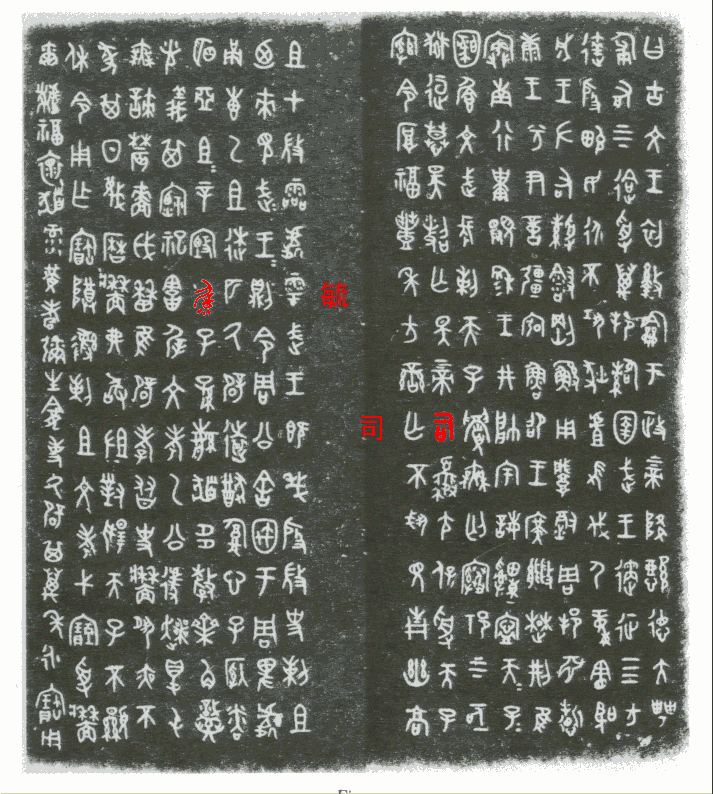 But 后/育/毓 and 司 are not 100% exchangeable, as the inscription on the 史墻盤 Shi Qiang pan shows. The
inscription (click image to enlarge) on this vessel contains both the character 司
and 毓. The first is with its following character,
ji 稷, the name of Hou Ji 后稷, 'Lord of Millet'; Hou Ji (personal name Zhou
Qi 周棄 or Ji Qi 姬棄; see also Shijing M245, M258, M275, M300) is seen as the first ancestor of the Zhou house and is also
worshipped as an agricultural god. The latter, 毓, is translated by Shaughnessy
as 'nurture' (Sources of Western Zhou History, p. 190), but as we have seen the character is a
picture of a woman giving birth, and we can also read it as 'bring forth
(heirs)'.
But 后/育/毓 and 司 are not 100% exchangeable, as the inscription on the 史墻盤 Shi Qiang pan shows. The
inscription (click image to enlarge) on this vessel contains both the character 司
and 毓. The first is with its following character,
ji 稷, the name of Hou Ji 后稷, 'Lord of Millet'; Hou Ji (personal name Zhou
Qi 周棄 or Ji Qi 姬棄; see also Shijing M245, M258, M275, M300) is seen as the first ancestor of the Zhou house and is also
worshipped as an agricultural god. The latter, 毓, is translated by Shaughnessy
as 'nurture' (Sources of Western Zhou History, p. 190), but as we have seen the character is a
picture of a woman giving birth, and we can also read it as 'bring forth
(heirs)'.
As we can see in the name Hou Ji 后稷, hou 后 is a title, and on bronzes
we know it as a posthumous title for women in high positions (The Great Bronze Age of China,
p. 183). The fact that it can be a posthumous title is strengthened by
the bronze vessels found in the tomb of Fu Hao/Zi 婦好/子. Most of the
vessels contained the name 'Fu Hao/Zi 婦好/子', but a few others contained
inscriptions which are read as Si Mu Xin 司母辛 and Si Tu/Qiao Mu 司 母. It is believed that 'Fu Hao' was the name of
the occupant when she was alive, 'Xin' her ritual name, and Mu Xin the
posthumous name. (Zheng Zhenxiang, A Study, p. 83). It is assumed that
the vessels with the Si Mu Xin and Si Tu Mu inscriptions were made after the
death of Fu Hao. The fact that the characters hou 后 and si 司 also
refer to rituals of sacrifice to ancestors and deities makes the meaning of a
posthumous title more plausible.
母. It is believed that 'Fu Hao' was the name of
the occupant when she was alive, 'Xin' her ritual name, and Mu Xin the
posthumous name. (Zheng Zhenxiang, A Study, p. 83). It is assumed that
the vessels with the Si Mu Xin and Si Tu Mu inscriptions were made after the
death of Fu Hao. The fact that the characters hou 后 and si 司 also
refer to rituals of sacrifice to ancestors and deities makes the meaning of a
posthumous title more plausible.
To summarize all this: 后 is mostly used as a title, for men, but occasionally also for women. For women it seems to have had a meaning like 'bringer of (a) heir(s)'.
It is possible that the 女 part was added to emphasize that the title is that of a woman. Which brings us back to gou 姤. This character is normally translated as 'to meet', this is mainly inspired by the Tuan 彖 and Xugua 序卦 parts of the Ten Wings, which say that 姤 means yu 遇, 遇 = '(to) meet'. Tang dynasty scholar Lu Deming 陸德明 says in his Zhouyi Shiwen 周易釋文
薛云,古文作 '遘'. 鄭同.
Xue says, the old text say 'gou 遘 '. Zheng says the same.
(漢語大字典 1045.16; 高亨, 周易古經今注, p. 285)
Xue is Xue Yu 薛虞, a Confucian scholar from the Han dynasty of who we do not know
much (Bent Nielsen, A Companion to Yi Jing Numerology and Cosmology, p.
282). Zheng is Zheng Xuan 鄭玄 (127-200), another but more influential Confucian
xiangshu 象數 scholar who wrote commentaries to the Classics (A
Companion, p. 333-334). 遘 and 姤 have the same pronunciation, which is
probably one of the reasons why they are linked to each other.
The Shuo Wen comes yet with another character for 姤, it says: 姤, 偶也. "姤 means ou 偶". 偶 has many meanings, of which one is 'a mate' or 'to mate', and this is probably the reason why several writers translate hexagram 44 as 'copulating'. But the Shuo Wen is the only dictionary which explains 姤 in this direction. There are no texts available where 姤 is used in the meaning of 'to copulate'.
Some see 姤 as a contracted form of 司母, the phrase we have seen in the Fu Hao Si Mu Xin inscription mentioned earlier. In his dissertation The Tomb of Fu Hao Kian-Chow Kwok mentions Tang Lan who "suggested that 'si' 司 (which he reads as hou 后) and 'mu' 母 (which he reads as nü 女) might be combined as a bisyllabic graph hou 姤, which meant 'queen' " (p. 50). As we have seen the character 后 is also written backwards 司, and in bronze inscriptions the old form of 母 is often similar to the old form of 女.
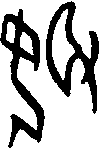
 There
is an oracle bone inscription which supports this view. Tang Lan reads
司母 as 姤, but the 甲骨文字典 does it the other way around: it shows an
inscription (left; click to enlarge) with a character which is composed of the components 司 and
女, and according to the 甲骨文字典 it should be read as 司母 (p. 999). 司 and 女
can be combined to si
㚸, which Virginia Kane reads as 'mother of heirs' (Art-Historical Issues
Arising from the M5 Burial at An-yang (paper), p. 23-25; quoted in Kian-Chow
Kwok, The Tomb of Fu Hao, p. 51);
There
is an oracle bone inscription which supports this view. Tang Lan reads
司母 as 姤, but the 甲骨文字典 does it the other way around: it shows an
inscription (left; click to enlarge) with a character which is composed of the components 司 and
女, and according to the 甲骨文字典 it should be read as 司母 (p. 999). 司 and 女
can be combined to si
㚸, which Virginia Kane reads as 'mother of heirs' (Art-Historical Issues
Arising from the M5 Burial at An-yang (paper), p. 23-25; quoted in Kian-Chow
Kwok, The Tomb of Fu Hao, p. 51); 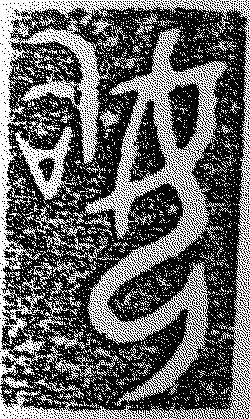 the 漢語大字典
reads it as si 媤, 'name of a girl' (p. 1041.1, 1066.2). The bronze
version of 㚸 as given by the 金文大字典
(p. 1467-1469) could equally well be seen as the precursor of 姤 (see image on the right). The 金文大字典 reads 㚸 as si 姒, a title
for the wife of an elder brother (漢語大字典,
p. 1034.3).
the 漢語大字典
reads it as si 媤, 'name of a girl' (p. 1041.1, 1066.2). The bronze
version of 㚸 as given by the 金文大字典
(p. 1467-1469) could equally well be seen as the precursor of 姤 (see image on the right). The 金文大字典 reads 㚸 as si 姒, a title
for the wife of an elder brother (漢語大字典,
p. 1034.3).
As always it is difficult to come to a final conclusion regarding the meaning of 姤. It is very well possible that it is the title of 'queen', but as we have seen it is probably a posthumous title. It is also possible to see it as 㚸, the wife of an elder brother. But the character also refers to a heir, and maybe the 女 part denotes a female heir, or at least a daughter of high descent. This is how I will see 姤 - for now. Let's see if the text of the Yi can give some clarification.
The Judgment of hexagram 44 says
女壯.勿用取女.
The woman is strong. Do not marry the woman.
If we assume that "女壯.勿用取女" says something about 姤,
then the meaning of si 㚸, 'the wife of an elder brother' does not fit for 姤,
after all, a married girl can not be 'taken'. The meaning of 'queen' fits better,
but if we take it as a posthumous title the sentence almost becomes a
shamanistic ritual, in which a shaman wants to be posessed by the spirit of a
deceased queen but is advised not to do so because 'the woman is too strong'.
 But then we see qu 取 with a meaning that it probably did not have.
取 normally means 'to take by force',
but the phrase 取女 is most
probably equal to the character qu 娶,
which has the same pronunciation and components, and means 'to marry' (漢語大字典,
p. 1056.1). That 取 can have the
meaning of 娶 is apparent in the
Shijing, where it is used in the meaning 'to marry' (see odes M101, M138, M158
and M261). In the Mengzi 孟子 ode
M101 is quoted, "取妻如之何、必告父母", but 取
is replaced with 娶 (Legge,
The Works of Mencius, p. 345), which shows that in this case 取 and 娶
were considered as exchangeable. And 女
might be a short form for 妻.
But then we see qu 取 with a meaning that it probably did not have.
取 normally means 'to take by force',
but the phrase 取女 is most
probably equal to the character qu 娶,
which has the same pronunciation and components, and means 'to marry' (漢語大字典,
p. 1056.1). That 取 can have the
meaning of 娶 is apparent in the
Shijing, where it is used in the meaning 'to marry' (see odes M101, M138, M158
and M261). In the Mengzi 孟子 ode
M101 is quoted, "取妻如之何、必告父母", but 取
is replaced with 娶 (Legge,
The Works of Mencius, p. 345), which shows that in this case 取 and 娶
were considered as exchangeable. And 女
might be a short form for 妻.
We have seen that 后 also refers to a woman who brought forth a heir, but a heir is only possible if the woman is married. In that case 姤 meaning 'queen' in the context of the Judgment text does not make much sense, because if the title implies that she has given birth to a heir, this also means she is already married.
Zhuang 壯 means 'strong, mighty' and it is almost only used to describe strength of boys or men. The fact that in the Judgement of hexagram 44 it is used to describe a strong woman is odd. But it might agree with the sixth line of hexagram 44, where 姤 also occurs:
姤其角.吝.無咎.
Gou its 'horns'. Regret. No misfortune.
Although jiao 角 means 'horn' it also has a lot of other meanings. One very interesting meaning is given by the 漢語大字典,namely that of the hairstyle of a boy who is becoming a man (p. 3919.1; see also 漢語大詞典 10.1345). The Liji says it is specifically the hairstyle of a boy, and that the hairstyle of a girl has another name: "男角女羈".Jiao 角 is the hairstyle for a boy, ji 羈 that of a girl.
[Update 20-07-2005] It is interesting to notice that the phrase 其角 also occurs at 34-3 and 35-6, and that in all three instances the text is not entirely positive. Further research is necessary to see what the phrase exactly means .
In the Judgment of hexagram 44 it is said that the woman is zhuang 壯, a word only used with men or boys. In the sixth line we have a girl wearing the hairstyle of a boy. The picture we get from this is that of a Mulan, a girl who behaves like a boy, which of course is highly impropriate. Such a girl is unlikely to find a suitable partner, and will surely cause regret. It is however not misfortune caused by the ancestors (the original meaning of 咎), which could mean it will pass. The girl is of high descent, no doubt that in time she will find a husband.
Donderdag, 7 juli 2005
To be or not to be
 Again there is somebody - whom I do not know, as far as I can see - who calls me a sinologist. If eight more people call me a sinologist, could that mean I actually am one? Maybe I should think about putting it on my business card. Harmen Mesker - sinologist. Hm, does not sound bad.
Nah. Confucius said:
The most important thing is to use the correct words.
If we don't use the correct words,
we live public lies.
If we live public lies,
the political system is a sham.
When the political system is a sham,
civil order and refinement deteriorate.
When civil order and refinement deteriorate,
injustice multiplies.
As injustice multiplies,
eventually the electorate is paralyzed
by public lawlessness.
(Lunyu 13-3)
Gee. I do not want to be responsible for that. Sorry, no 'sinologist' for me.
Language
Huanying, huanying!
Many people (including me) have problems viewing the Chinese characters on my site. Even Firefox, which is the best browser for it, does not always do the job right. To help visitors viewing the articles I have converted some of them to pdf format, which can be viewed with Acrobat Reader. If you see this icon

at
the beginning of an article, you can view that article as a pdf by clicking on the icon.
Disadvantage of these pdfs is that you cannot click links, or images
for enlargement. So keep it alongside with the original web article and
you should do fine.
Categorieën
Zoeken
Add me to your blog, FB, Twitter...

